
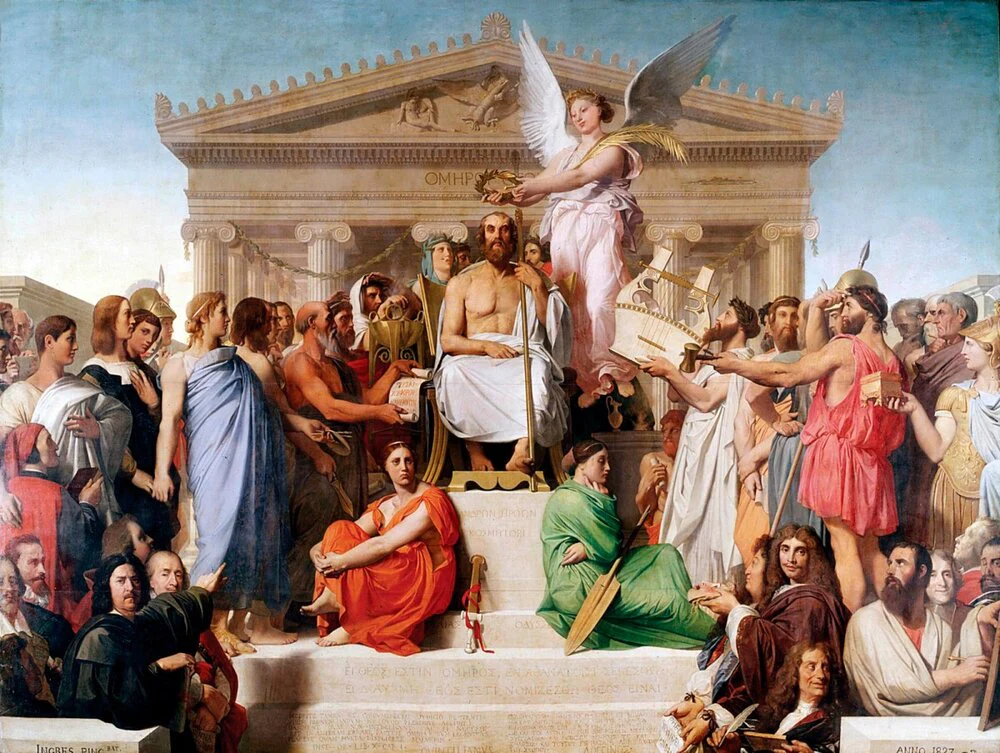
The same basic needs, such as confident negotiating, a safe trade, and effective communication, have been the pillars of the history of trade for thousands of years. The concept of modern finance was influenced by ancient Greece, which not only had an established economy but also a god of trade.
There is always an effort to make trades quicker and safer, and technology has always led the way towards this. Blockchain and cryptocurrencies have brought a new era nowadays, one that would surely amaze the ancient Greeks who first systematized trade.
Trade in Ancient Greece
One of the earliest advanced market economies ever to be created in the West was developed by the ancient Greeks. In any Greek city, the primary market was the agora. This is where traders met to exchange products such as olive oil, wine, pottery, and cloth.
The Greeks worshipped Hermes as a messenger god who used to check all the business dealings. Hermes was the patron of traders, tourists, and whoever was making an exchange. Boundaries and crossroads in Greece were marked by statues known as herms to guide traders and as a symbol of safe passage.
Greek cities, such as Athens, started to issue standard coinage (drachmas) consisting of coins made of silver. This invention transformed business because it provided a standard medium of exchange that was supported by the power of the state. The Athenian “owl” coins were so dependable that they reached out across the Mediterranean world.
From The Romans To The Renaissance
Greek trading customs were passed on to the Romans, who extended them throughout their empire. The Roman roads were the reason why the far-off provinces were connected, and all this allowed merchants to bring goods to the market with better efficiency than before. The denarius became the common currency in the whole empire, and deposits, loans, and exchange of currencies were provided by the Roman banking houses.
Italian city-states such as Venice and Florence grew to be power centers of commerce during the Middle Ages. One of the earliest international banking networks was established by the Medici family, with branches in Europe. The challenge that these medieval innovations were meant to solve was the issue of how to engage in trade over a distance where the physical transportation of coins was considered a risk. Merchants used paper notes to send money without carrying gold or silver. This was an early form of modern money.
The Rise of Modern Banking
Modern banking started in the 1600s-1700s. In 1609, the Bank of Amsterdam was established, and people could transfer money through written documents as opposed to the bulky coins. Subsequently, in the Industrial Revolution, stock exchanges emerged, enabling companies to get the finance of the stockholders.
The 20th century saw the beginning of electronic systems being used instead of paper transactions. Credit cards were introduced in the 1950s, and they allowed owners to make purchases without cash. The SWIFT network was launched in 1973, and the entire world was literally given a chance to send and receive money electronically. The digital market became accessible in the 1990s with the internet revolution allowing the introduction of e-commerce sites and internet payment systems like PayPal.
The Revolution Of Crypto
The idea of a decentralized digital currency that has no central authority was a radical idea brought about by Bitcoin in 2009. Bitcoin became the first token that involved peer-to-peer transactions documented on a distributed registry with the use of blockchain technology in order to be transparent and practically impossible to alter.
This innovation solved most of the constraints of conventional finance. The cryptocurrency payments would be able to make payments within minutes, as opposed to days, particularly on cross-border operations. After the success of Bitcoin, new cryptocurrencies emerged in the thousands, all trying to find a solution to various problems. Ethereum had smart contracts, Ripple had institutional payment systems, and Litecoin had faster speeds of transactions.
Platforms to trade digital assets have gained popularity, and users have been granted access to various cryptocurrencies. The big exchanges like Coinbase, Binance, and Kraken have millions of users across the world, and platforms like XRP exchanges specialize in a specific digital asset.
Today, online marketplaces are the modern open-air marketplaces of old. They enable individuals to sell and purchase all forms of digital products 24 hours a day and anywhere in the world. Crypto news outlets like CCN were created in an attempt to cover this dynamic world and give some analysis to enable people to understand the otherwise confusing cryptocurrency world.
Smart contracts are automated and blockchain-based contracts. Oracles are services that add real-world information to the blockchain, like prices or weather, in the way ancient Greeks referred to the Oracle of Delphi to get its guidance.
Final Wrap
Trading history dates back from the ancient Greek markets to the present cryptocurrency systems. Some of the most important ideas were developed by the Ancient Greeks: the common currency, reliable intermediaries, and person-to-person communication. These ideas were spread by the Romans. Early credit was invented by medieval traders, electronic transfers were invented by modern banks, and decentralized and digital trading was introduced by cryptocurrency.
Technology has gone beyond the use of physical coins and herms to include digital tokens and a global blockchain network – every era expanding on the previous one to address new problems.
But the human motives are much the same: the necessity to exchange value in a secure and fair manner, which Hermes, the Greek god of commerce in the ancient times, would be happy of as well as amazed by the technology that has enabled such things.
