
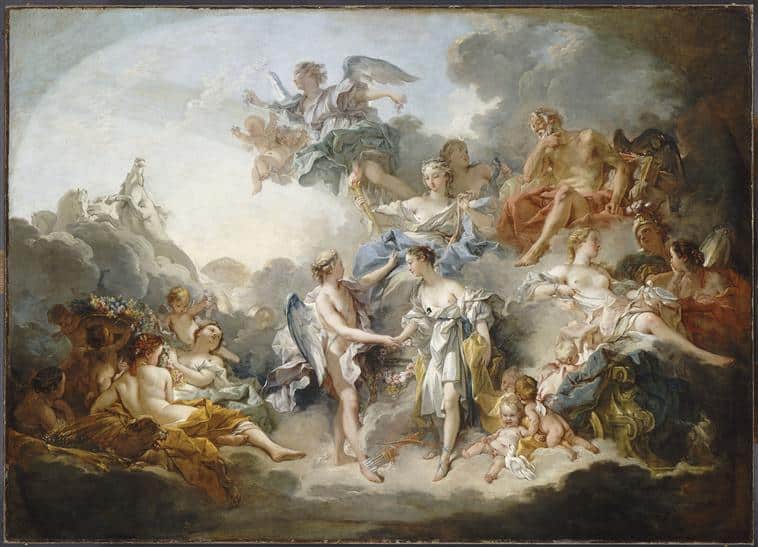
Long ago, people believed in many gods and goddesses who each had control over different parts of life and nature. The ancient Greeks had their own set of gods, and the Romans later adopted many of them with different names but similar roles. The knowledge about these gods helps us understand how people in those times explained the world around them.

Jupiter/Zeus
The Romans called the father of the gods Jupiter, while the Greeks called him Zeus. He was the god of thunder and ruled over the council of gods.
In some classical Greek myths, Zeus was occasionally equated with Hades, the god of the underworld—an example of which might be the image shown on the right.
Zeus was primarily worshipped as the god of the sky. The name Jupiter derives from the Indo-European root dieu/pater, where dieu is related to dies (meaning “day”), so his name roughly means “god of the daytime sky.” Known as Deus Optimus Maximus (D.O.M.), he was honored as the supreme state god in temples and served as the guarantor of public order. Even during the early imperial era under Augustus, poets likened the emperor to Jupiter.
Mythology, especially in the works of Ovid, often portrays Zeus as a womaniser who had numerous affairs with mortal women, much to the jealousy of his wife Juno (Hera).
Jupiter, together with Juno and Minerva, formed the Capitoline Triad—a trio of gods worshipped as the state deities on Rome’s Capitoline Hill.
Juno/Hera

Juno is the Roman counterpart of the Greek goddess Hera. She was both the wife and sister of Jupiter (Zeus). As the goddess responsible for marriage, she also oversaw childbirth. Women invoked Juno during labor, and after the birth, food offerings were made to her for an entire month. This tradition reflects the reality that childbirth was far more dangerous in ancient times than it is today, even in countries with advanced medicine.
In addition to her role in marriage and childbirth, Juno protected young warriors.
Juno was part of the Capitoline Triad, a trio of deities worshipped on Rome’s Capitoline Hill. Although a temple dedicated to her once stood there, no visible remains of it survive today.
In Virgil’s epic poem, the Aeneid, Juno’s wrath drives much of the story. She harbors anger against the Trojans because they are favored by Venus (Aphrodite), who had won a beauty contest against Juno. The three goddesses—Venus, Juno, and Minerva (Athena)—had competed to see who was the most beautiful. The Trojan prince Paris was chosen to judge. Venus promised Paris the love of the most beautiful woman in the world—Helen, wife of the Greek king Menelaus. Paris’s abduction of Helen sparked the Trojan War. After Troy’s fall, Aeneas fled and eventually reached Italy, fulfilling his destiny.
Athena/Minerva
Minerva was likely introduced to Rome as the goddess of the Sabines, a neighbouring Italic people. She was not originally Roman but Italic in origin. Later on, Minerva became identified with the Greek goddess Athena. The image on the right depicts Athena as a warrior goddess—a role she was already worshipped for by the Romans even before this identification. Minerva was also regarded as the goddess of wisdom.
According to Greek myth, Athena was Zeus’s favorite daughter. She was famously born from his head, which symbolized her deep connection to wisdom and intellect.
During the Trojan War, Athena sided with the Greeks. She played a key role in calming the anger of Achilles, the central figure in Homer’s Iliad.
Athena was the patron goddess of the city of Athens, while Minerva held a similar status in Rome, where she was considered one of the city’s protectors. Along with Jupiter and Juno, Minerva formed the Capitoline Triad (as mentioned earlier).
Apollo
Apollo has the same name in both Roman and Greek mythology.
He is the son of Jupiter and Leto (known as Latona in Roman myth). His twin sister is Diana (the Greek Artemis).
Apollo is the god of the arts, especially music and poetry, but he is also the god of prophecy. His most important sanctuary was at Delphi, home to a famous oracle. Additionally, he was revered as the god of archery.
In mythology, Apollo is said to have slain the dragon Python, a feat that granted him his prophetic powers.
During the Trojan War, Apollo supported the Trojans against the Greeks.
One well-known myth tells how Niobe mocked Leto, boasting that she had fourteen children while Leto had only two, Apollo and Diana. In response, Apollo and Diana killed all of Niobe’s children. This story is recounted in Ovid’s epic Metamorphoses and was a popular subject in ancient art. The accompanying image depicts this tragic event.
Politically, Augustus, Rome’s first emperor, dedicated a temple to Apollo on the Palatine Hill, right next to his residence. He also planted laurel trees there, which were sacred to Apollo.
Apollo is commonly represented by his lyre—a stringed instrument—and his bow. The laurel tree was also closely associated with him.
Diana/Artemis

The Greeks called her Artemis, while the Romans knew her as Diana. She was Apollo’s twin sister and was revered as the goddess of hunting and the moon. Diana was especially important to women and girls, and although she remained a virgin, she was also considered a protector during childbirth.
Many temples across Rome and its provinces were dedicated to Diana. She was often worshipped alongside her twin brother Apollo.
In mythology, Diana is commonly portrayed as a huntress. One famous story from Ovid’s Metamorphoses tells of the hunter Actaeon, who accidentally saw her naked while she was bathing. As punishment, Diana transformed him into a stag, and he was subsequently torn apart by his own hunting dogs, who no longer recognized their master.
Her primary symbol is the bow.
Mercury/Hermes
Hermes, known as Mercury in Roman mythology, was not only the messenger of the gods but also the god of trade and cunning — qualities that perfectly reflect the spirit of chance and excitement found in gambling. His ability to take on many forms and approach people unnoticed mirrors the unpredictable nature of today’s gaming world, where every player can find their own strategy to win.
This mythical spirit lives on in modern times at Cruisino casino, where players can dive into an exciting world of chance and enjoy a wide selection of slots inspired by ancient Greek themes. It’s the perfect place to experience the thrill of myth combined with the best of today’s online gaming.
Venus/Aphrodite
Venus was the goddess of love and enjoyed great popularity among the people. She is celebrated in countless love poems. Her Greek counterpart is Aphrodite. The Roman poet Lucretius famously begins his didactic poem De rerum natura (On the Nature of Things) with a vivid description of a triumphal procession of Venus.
The first temple dedicated to Venus in Rome was built in the 3rd century BC. There was also a shrine to Venus Cloacina—Venus of the sewers—an unusual and somewhat cheeky title reflecting her role in purifying the city’s drains. The Christian philosopher Aurelius Augustinus mocked this Venus Cloacina, seeing it as a symbol of the folly of polytheism.
Venus (Aphrodite) was married to Vulcan (Hephaestus), the god of fire and craftsmanship. She is well known for her adulterous affair with Mars (Ares), the god of war—a story often told alongside tales of Vulcan. More about this complicated relationship can be found at the bottom of this page.
Politically, Gaius Julius Caesar traced his family lineage, the Iulii, back to Venus, believing her to be his ancestor. Whether he truly believed this or used it as propaganda is unclear. His adopted son Augustus also identified as a Iulian, claiming descent from Venus.
Venus’s symbols include dolphins, pairs of doves, mirrors, and seashells.
Mars/Ares
Mars is the Roman counterpart of the Greek god of war, Ares. He is the son of Jupiter (Zeus) and Juno (Hera). Mars held greater importance for the Romans than Ares did for the Greeks. This is especially evident in the myth of Rome’s founding, where the twins Romulus and Remus are said to be the children of Mars and Rhea Silvia (also called Ilia in some versions).
Mars’ violent nature is reflected in this story: the twins were conceived through rape, and their own lives were marked by violence, culminating in Romulus killing Remus after feeling mocked by him. While Ares represented brutal combat among the Greeks, Athena—another goddess of war—was associated more with strategy and skill in warfare.
Mars is often depicted wearing a helmet, symbolizing his warrior role.
Ceres/Demeter
Ceres is the goddess of crops and the harvest. Before sowing, the flamen Cerialis—her dedicated priest—offered sacrifices to her. Over time, she was identified with the Greek goddess Demeter. A bustling market was held at her temple, making it an important place for the Romans. The office of aedile, responsible for public buildings and markets, is believed to have evolved from the role of the head priest of Ceres’ temple.
Her distinguishing symbol is the ear of corn.
Neptune/Poseidon
The Romans worshipped the Greek sea god Poseidon under the name Neptune. He was the son of Cronus and Rhea. Originally, Neptune was also responsible for earthquakes, but this role diminished in Roman belief, where he became primarily the god of the sea and maritime trade.
Neptune was a brother of Zeus (Jupiter) and husband to Amphitrite. In literature, he is often portrayed as angry and vengeful. For example, in Homer’s Odyssey, Neptune punishes Odysseus for blinding his son, the cyclops Polyphemus. As a result, Odysseus is forced to wander the seas for ten years before finally returning home to Ithaca.
In the Roman comedy Mostellaria by the poet T. Macchius Plautus, the merchant Theopropides prays to Neptune after narrowly surviving a fierce storm that destroyed all his possessions. His prayer is somewhat ironic, as he vows never to sail again—making his thanks to Neptune somewhat doubtful.
In Virgil’s great epic, the Aeneid, Neptune is shown in a more positive light. When the Trojans, led by Aeneas, are caught in a storm caused by the goddess Juno, Venus persuades Neptune to calm the seas, allowing the survivors to safely reach Carthage.
Bacchus/Liber/Dionysus
The Romans incorporated much of the Greek god Dionysus into their own god Bacchus, who was the god of wine, celebration, and fertility.
The name “Bacchus!” originally served as a call to invoke the god. Before Bacchus became widespread, the ancient Italic god of festivals and wine was Liber, a name commonly used during Roman festivals. However, in poetry and later religious contexts, Bacchus became the preferred name. Around 500 BC, the cult of Dionysus was introduced to Rome from Greece, where he was worshipped alongside the goddess Ceres, who was also associated with fertility.
Two major festivals connected to Bacchus were the Ludi Cereales and the Liberalia. These events can be seen as wine festivals with strong religious significance.
In 186 BC, the so-called Bacchanalia scandal shook Rome. What actually happened during these events remains a subject of debate among scholars. Although the Roman historian Livy provides an account, its reliability is often questioned. According to surviving texts, including a decree engraved on a bronze tablet, the Roman Senate was disturbed by the secretive and wild nature of the Bacchic celebrations and consequently banned their associated groups.
Bacchus’ main symbols are the grapevine and the tiger.
Vesta/Hestia
The goddess Vesta, modeled after the Greek Hestia, was the guardian of the hearth fire. A distinctive round temple dedicated to her stood prominently in the Roman Forum. The Vestal Virgins, priestesses serving Vesta, were highly respected and enjoyed many special privileges. Having a daughter chosen as a Vestal Virgin was considered a great honour for a family.
Membership in this priestly order was temporary; the women did not have to serve as Vestal Virgins for their entire lives. Their main duty was to keep an eternal fire burning, a sacred symbol of Rome’s security and prosperity.
Vulcan
The Greek god Hephaestus, god of blacksmithing and volcanoes, was known as Vulcan to the Romans. Vulcan forged magnificent works of art and powerful weapons for the gods. He was a son of Juno (Hera).
Vulcan was married to Venus. One of the most famous myths about them tells of Venus’ adultery with Mars (Ares). When Vulcan caught the two lovers, he crafted an iron net and trapped them in it as punishment.
His distinguishing features are the hammer and a felt hat.
