

Life in Ancient Greece combined civic responsibility, religious devotion, intellectual pursuit, and cultural sophistication. Greeks balanced practical skills with spiritual and philosophical inquiry, navigating their world with curiosity, reason, and reverence for the divine. Their achievements in art, architecture, philosophy, and civic life have left a lasting legacy.
Ancient Greece was a civilization of remarkable cultural, political, and social complexity. Life varied depending on whether one lived in Athens, Sparta, or a smaller polis, but some aspects were shared across the Greek world:
- Citizens: Adult men with full political rights, responsible for voting, military service, and participation in civic life.
- Metics: Free non-citizens who lived and worked in the city, often merchants or artisans.
- Slaves: People without freedom who performed labor-intensive tasks in households, agriculture, and workshops.
Families often lived in modest homes where daily life centered around cooking, weaving, education, and religious practices. Education, particularly in Athens, included reading, writing, mathematics, music, and physical training.
Sparta, by contrast, emphasized military training, discipline, and communal living for boys from a young age.
Religion and Beliefs
Religion was woven into every aspect of Greek life. The Greeks believed in a pantheon of gods who controlled natural forces and human destiny. The major gods included:
- Zeus: King of the gods, ruler of the sky, and enforcer of justice.
- Athena: Goddess of wisdom, warfare, and crafts.
- Apollo: God of music, prophecy, and healing.
- Aphrodite: Goddess of love and beauty.
Religious practices included offerings, sacrifices, festivals, and oracles. Temples were constructed to honor the gods, and daily rituals often took place at household altars. Greeks also believed in spirits, nymphs, and heroes whose deeds were celebrated in myths.
Festivals and Civic Religion
Festivals played a central role in Greek life, providing religious, cultural, and social functions. Some key aspects included:
- Panathenaea: A festival in Athens honoring Athena, featuring athletic competitions, music, and sacrifices.
- Olympic Games: Held every four years in Olympia to honor Zeus, drawing competitors from across the Greek world.
- Dionysia: Festivals dedicated to Dionysus, god of wine and theater, including dramatic performances and processions.
These events were not only religious but also civic gatherings, reinforcing social bonds, political identity, and cultural pride.
Philosophy and Daily Thought
Greek philosophy sought to explain the world through reason and observation. Thinkers like Socrates, Plato, and Aristotle explored questions about morality, the nature of knowledge, and the ideal society. Philosophy influenced education, politics, and even religious interpretation, encouraging citizens to reflect on ethical living, civic duty, and personal virtue.
Greek Architecture and Art
Greek society left a lasting legacy in architecture and art. Key features included:
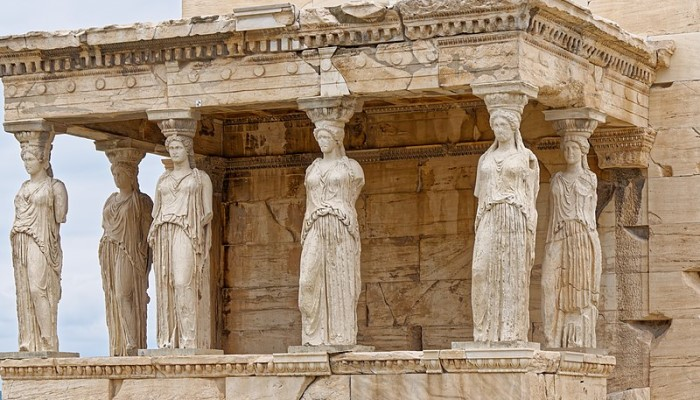
- Temples: Elaborate structures dedicated to gods, such as the Parthenon in Athens.
- Sculpture: Life-like statues celebrating human form, gods, and heroes.
- Pottery: Decorated with mythological scenes, daily life, and athletic events.
These works expressed religious devotion, social values, and aesthetic ideals, shaping the cultural identity of Ancient Greece.
Education and Intellectual Pursuits
Education was valued, especially in Athens. Young boys learned:
- Literacy and mathematics: Foundational skills for civic life.
- Music and poetry: Cultivating appreciation for harmony and storytelling.
- Physical training: Preparing for military service and athletic competitions.
Girls’ education focused primarily on household skills, though women also participated in religious rites and sometimes held influence in local cults.
Trade and Economy
Greek cities thrived on trade, both maritime and overland. Products included:
- Olive oil and wine: Staple exports and cultural commodities.
- Pottery and crafts: Sold locally and abroad.
- Grain and textiles: Essential for sustenance and commerce.
Harbors and trade networks connected Greece to Egypt, the Near East, and Italy, facilitating exchange of goods, ideas, and cultural practices.
The Greek world treated risk as something that required structure: from oracular consultations to civic laws and ritual boundaries, chance was never left entirely to randomness. Interestingly, the same principle shapes modern approaches to regulated digital entertainment. In places like Michigan, online gaming markets operate under strict oversight from state authorities, ensuring transparency, fairness, and clearly defined rules.
Although the contexts are vastly different, both systems show how societies seek to balance uncertainty with order.
Beliefs About Fate and the Afterlife
Greeks believed that life was influenced by both human agency and divine forces. Concepts included:
- Moira: The idea of fate, represented by the three Fates controlling life’s thread.
- Hades: The underworld, where most souls went after death.
- Elysium: A paradise for heroes and the virtuous.
Funerary rituals involved offerings, grave markers, and sometimes elaborate tombs. These practices reflected a desire to honor ancestors and ensure continuity of family and memory.
Greek Warfare and Civic Duty
Warfare was a central aspect of Greek society. Citizens were expected to defend their polis, often forming hoplite armies equipped with shields, spears, and armor. Key aspects included:
- Phalanx formation: A tactical innovation for collective defense and offense.
- Training: Young men practiced combat, discipline, and teamwork.
- Honor and valor: Successful soldiers gained social recognition and civic prestige.
Military service was both a duty and a means of reinforcing communal identity.
Mythology and Storytelling
Greek myths explained natural phenomena, human behavior, and the divine order. Common themes included:
- Heroic exploits: Tales of Perseus, Heracles, and Odysseus.
- Moral lessons: Stories illustrating consequences of hubris, greed, and impiety.
- Cultural cohesion: Shared stories reinforced values across the Greek world.
Mythology permeated art, theater, and festivals, ensuring its lessons were widely known and culturally significant.
Greek Influence on Modern Culture
Ancient Greece profoundly shaped Western civilization. Its influence can be seen in:
- Democracy: The Athenian model of civic participation.
- Philosophy: Foundations of ethical and rational thought.
- Architecture and art: Classical styles still admired and emulated today.
- Sporting tradition: The Olympic Games continue as a global cultural legacy.
Interest in Greek culture persists, inspiring literature, education, games, and public discourse.
Conclusion
Life in Ancient Greece combined civic responsibility, religious devotion, intellectual pursuit, and cultural sophistication. Greeks balanced practical skills with spiritual and philosophical inquiry, navigating their world with curiosity, reason, and reverence for the divine. Their achievements in art, architecture, philosophy, and civic life have left a lasting legacy.
Even today, echoes of their approach to structured risk and strategy can be found in modern entertainment. Legal online gambling in Michigan, with regulated platforms and secure transactions, mirrors the Greek blend of chance, skill, and ethical oversight.
By studying Ancient Greece, we gain insight not only into history but also into timeless human values: participation, curiosity, and the desire to understand both the natural and the divine.
