
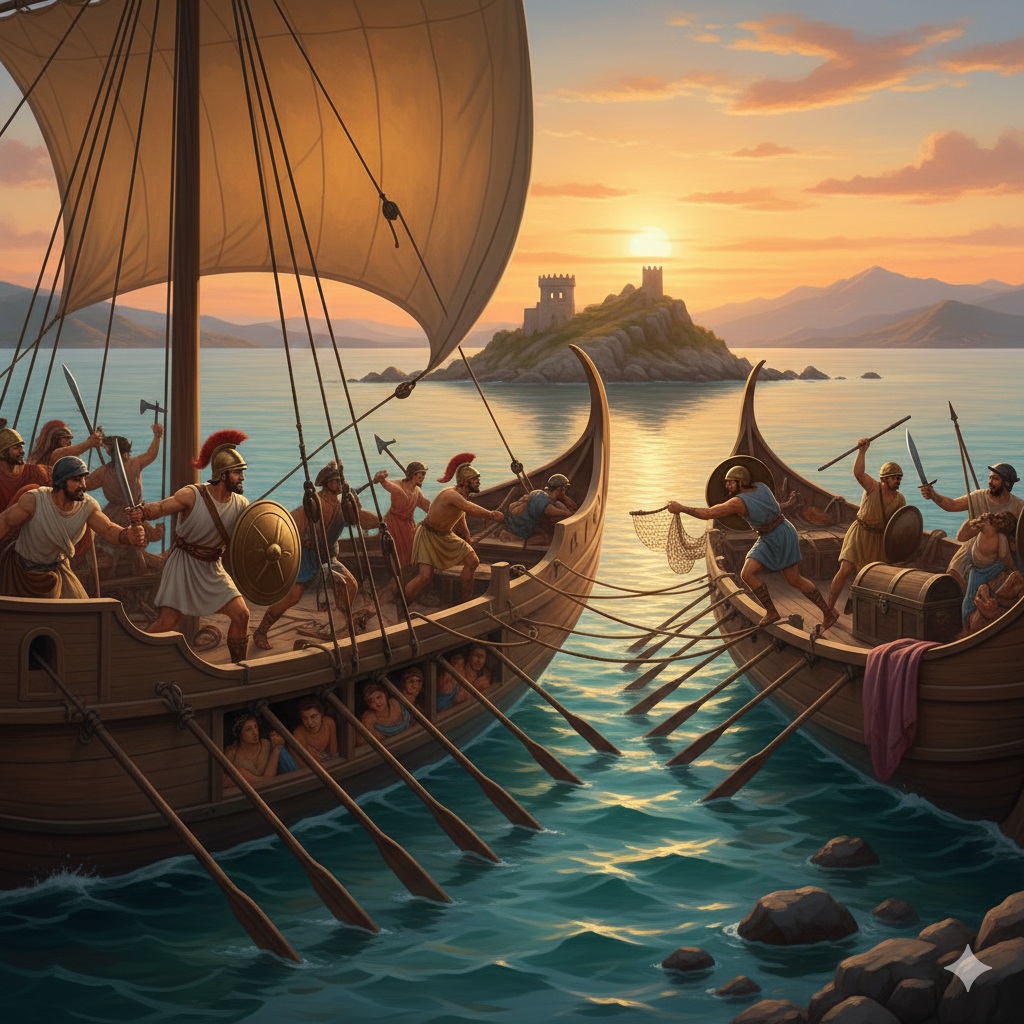
Piracy was an enduring, and often normalized, feature of life in the ancient Aegean and Eastern Mediterranean. Far from being isolated criminal acts, maritime raiding was deeply intertwined with early seafaring, trade, politics, and the socio-economic structure of the Greek world.
The Geography of Opportunity
The very nature of the Greek landscape created the perfect environment for piracy:
- Mountainous Terrain: The rugged, mountainous interior of mainland Greece and the islands made overland travel difficult and dangerous. This pushed the primary movement of goods and people onto the sea, creating more targets for raiders.
- Ideal Bases: The long, intricate coastline and the multitude of small, often barren islands in the Aegean provided countless hidden coves, sheltered inlets, and promontories that served as perfect, discreet bases for pirate fleets.
- Reliance on Sea Trade: As trade routes expanded, the volume of valuable cargo—including grain, wine, oil, metals, and, most importantly, human captives—increased, making the maritime environment an economic epicenter.
For those whose imaginations are captured by the daring tactics and high-stakes maneuvering on the ancient seas, the experience of a life of plunder can be brought to life in a different way. Games that simulate this kind of feeling of fun and high stakes can be found at the Big Pirate, allowing players to test their skill and luck against the currents of fate. It is a thrilling way to experience the strategic challenge that defined these ancient voyages, where every decision could lead to immense riches or ruin.
The Fine Line: Pirate, Trader, or Warrior?
In the early periods of Greek history, the distinction between a pirate, a merchant, and a warrior was often blurred.
- Homeric Acceptance: In the Archaic and early Classical periods, as depicted in Homer’s Iliad and Odyssey (c. 8th-6th centuries BCE), the practice of raiding was not necessarily considered shameful or a moral outrage. Asking a stranger if they are a merchant or a raider (leistes) was a common social inquiry. Raiding for plunder was an accepted method for an aristocrat to gain wealth and status.
- Lexicology: The ancient Greek terms for pirate reflect this ambiguity:
- Lēistēs: This was the older, more general term, meaning “plunderer” or “armed robber.” It applied to both land and sea bandits.
- Peiratēs: A term that emerged later (c. 3rd-4th century BCE), derived from peira (“trial” or “attempt”), and came to denote maritime armed robbery specifically.
- State-Sponsored Raiding (Privateering): City-states often engaged in acts of state-sanctioned piracy (privateering) against their rivals, especially during times of war. For a state, labeling an enemy as a “pirate” was a common political tactic to justify aggression and claim the moral high ground.
Tactics and the Prize of Plunder
Ancient Greek pirates focused on speed, surprise, and securing the most valuable cargo: people.
- Vessels: Pirate ships were typically small, fast, and lightly built vessels like the hemiolia or myoparō. They were not designed for large-scale naval battles but for rapid transport of a large number of men. Their shallow draft allowed them to hide in small coves and quickly launch ambushes.
- Attack Methods: The goal was to swiftly board the prey vessel and overwhelm the crew with numerical superiority, avoiding a lengthy ship-to-ship fight. Pirates also frequently launched coastal raids to plunder vulnerable settlements near the shore.
- The Lucrative Cargo: Humans: While material goods were desirable, the most profitable plunder was human cargo. Captives were either held for ransom (especially wealthy or high-status individuals) or sold into the burgeoning slave trade at major slave markets like Delos and Side. Piracy was a significant mechanism for supplying the slave market.
Suppressing the Threat
The presence of a dominant naval power was the only reliable check on widespread piracy.
- The Minoan Precedent: The earliest known naval effort to curb piracy is credited to the legendary King Minos of Crete (during the Bronze Age). The Greek historian Thucydides credits Minos with establishing a navy (thalassocracy) to clear the sea of pirates and protect his revenues.
- Athenian Sea Power: During the height of the Classical Age, the power of the Athenian Navy (the Delian League) effectively provided a degree of security across the Aegean, primarily as a side effect of projecting Athenian dominance.
- The Post-Alexandrian Surge: Piracy surged dramatically after the death of Alexander the Great in 323 BCE, as his empire fragmented and no single power was strong enough to police the seas. This power vacuum led to the rise of notorious groups, most famously the Cilician pirates from southern Anatolia, who would later plague the Roman Republic until their defeat by Pompey in 67 BCE.
In conclusion, for the ancient Greeks, piracy was not a simple matter of law and order. It was a complex, persistent force woven into the fabric of the maritime economy. It reflected the lack of cohesive political control, the geographical reality of the Aegean, and a time when risk and reward at sea often depended on whether one was the merchant or the raider.
