
Being a history buff is a very common interest. It is crucial to stay informed and knowledgeable about past events and what happened before our time, simply because it can greatly help us to prepare for what lies ahead. History is a science and an amazing tool for predicting changes in society because they tends to be so cyclical. New technologies and ideologies drive the world forward all the time, but certain things come back in a different way, shape, or form. Some new norms and ideas become relevant, and there are always ways for the old ones to come back. What is more, many parallels exist between the past and the present, and those who care enough to see them can benefit from knowing them.
On the other hand, history is also very fun, especially if you are fascinated with a particular civilization, people, age, or famous figure. One example of that fascination comes in the form of Ancient Greece, arguably the most common starting point of people obsessed with the old times. It perfectly encapsulates everything that history is. As a long lasting civilization, it marked more than one age, changed the Mediterranean, Europe, and the World, and has had lasting consequences that continue to influence how we live to this day. Without its great cities, marvels, sciences, and philosophers, we would not be where we are right now.
With that in mind, how much do you know about the ways of Ancient Greeks, the real facts and history of this period, and not what inaccurate Hollywood movies like 300 tend to present as historical facts? Aspects of life in the Greek city states are an extraordinarily complex and fascinating journey to go through, so join us as we explore their pantheon of gods, their arts, the warfare and battles, and their daily lives and activities. It is well known that they enjoyed life and knew how to spend their time with games, especially with sports and wagering on them. If you enjoy gambling casino games yourself, learn how to deal Blackjack cards to get better at it.
The Greek Pantheon of Gods
Religion was at the heart of Ancient Greek life across the city states. It shaped the people’s worldview and daily routines as the Greeks believed in a pantheon of gods and goddesses who lived on Mount Olympus. They controlled various aspects of nature and human behavior. Chief among them was Zeus, the king of the gods and the god of sky and thunder. There was Athena, the goddess of wisdom, Poseidon, the god of the sea, and Aphrodite, the goddess of love. They were related in different ways and deeply human, with emotions like love, jealousy, anger, and favoritism.
These traits made them relatable to mortals, with whom they would supposedly have children called demigods (heroes), like Hercules. City states honored a particular patron god with temples, festivals, and sacrifices, like Athens for Athena, most notably. Oracles offered divine guidance, the most important one at Delphi, and religion was intertwined with civic duty, art, and politics. Myths about the gods were passed down to teach and explain natural phenomena, the origins of the world, and moral lessons.
Warfare and Militarism
Warfare was a central element of life in the Ancient Greek city states at different points of history. It shaped politics, economy, and identity, as the poleis conflicted with each other, but also with foreign aggressors. Military service was a key duty of citizenship, especially in Sparta and Athens. The iconic phalanx was the most common military formation, a tightly packed group of hoplites. A hoplite was a heavily armed and armored infantryman who fought shoulder to shoulder with spears and shields. Discipline and unity were vital, particularly in Sparta, where boys trained from childhood to become elite warriors. Athens had the strongest navy and was famous for it, but it also fielded strong land forces and citizen soldier participation.
Warfare was seasonal because soldiers were also farmers. The campaigns of the poleis took place in the summer months. During the Persian Wars, naval battles became crucial, and the Greek alliance was formed to defeat a vast Persian army and fleet. The Marathon and Salamis battles marked this chapter in the history of the Mediterranean. Military success brought prestige, land, title, and wealth, but prolonged wars, like in the case of the Peloponnesian War between Athens and Sparta. It devastated local economies, societies and ultimately made them weaker to foreign enemies. However, it did spur technological (Greek fire) and strategic innovations (phalanx, shield wall), as well as literature (Homer’s epics).
Pastime Activities and Daily Life
The Greeks of old enjoyed a wide range of pastimes that reflected their values, social structures, and connection to the divine and physical world. Athletics held a special place in their life and embodied ideals of physical excellence, competition, and honor. The Olympic Games were held every four years at Olympia in honor of Zeus. They were the most celebrated events, with many disciplines still relevant today. Local gymnasia served as centers for physical training and philosophical debate, strengthening both the body and the mind. Music, poetry, and storytelling were very popular entertainments at symposia, exclusive drinking parties for elite men where they engaged in discussions, performances, and games. Children had dolls, hoops, and knucklebones, and adults enjoyed board games and dice and often gambled while playing.
Drama festivals like the Dionysia attracted huge crowds to view tragedies and comedies performed in open air theatres, while religious festivals involved processions, feasts, and competitions. It was a community wide recreation with wine, food, and good times. As for daily life, it included walks through the agora (marketplace), philosophical debates, and social visits. They were not only leisure, but a way to reinforce cultural identity, civic pride, and philosophical reflection. In certain cities, like Sparta, military tactics and training were integral in the daily lives of men. Through play, sport, and performance, the people cherished principles that remain central to Western ideals of education and lifestyle millennia later.
Ancient Greece Facts and Trivia
As a modern country, Greece is famous for its amazing coastline, islands, food, culture, monuments, and overall as a top tier tourist destination. However, historically, they are famous for so much more, and many call it the birthplace of society, civilization, and much more. Here are some of the most fascinating facts and trivia about the country throughout the thousands of years of its existence.
The Birthplace of Democracy
Ancient Greece, particularly the city state of Athens (today’s capital), is credited with developing the world’s first form of democracy around the 5th century BCE. Unlike modern representative democracies, it was a direct democracy and its purest form, a system where male citizens participated personally in the decision making process by voting on laws and policies. No such democracy actually exists or has existed since.
The Origin of the Olympic Games
The Olympic Games began in Olympia in 776 BCE as a religious festival dedicated to the king of the gods, the deity of sky and thunder, Zeus. These ancient competitions included events such as foot races (running), discus throwing, chariot (horse) racing, and pankration, a no holds barred combat sport combining wrestling and boxing. All of these are staples of modern games.
Sparta’s Rigorous Military Culture
While Athens was all for diplomacy, science, and democracy, the Spartan society was centered entirely around warfare and discipline. Boys were taken from their families at the age of seven to begin a brutal military training program known as the agoge. It was designed to turn them into elite soldiers and loyal citizens of the state, which proved fruitful in the days of both conquering and defending.
Independent City States Across the Land
Rather than forming a unified nation, Ancient Greece was a collection of city states known as poleis. The most influential, successful, and therefore popular include Athens, Sparta, Corinth, and Thebes. Each had its government, military, and laws, though they shared language, religious beliefs, and cultural traditions.
The Trial and Death of Socrates
One of the most influential philosophers in history, Socrates, was put on trial in 399 BCE. He was accused of corrupting the youth and disrespecting the gods of Athens. Choosing not to flee, he accepted a sentence of death and drank poison hemlock, thus becoming a martyr for free thought.
Ancient Greek Theater and Acoustics
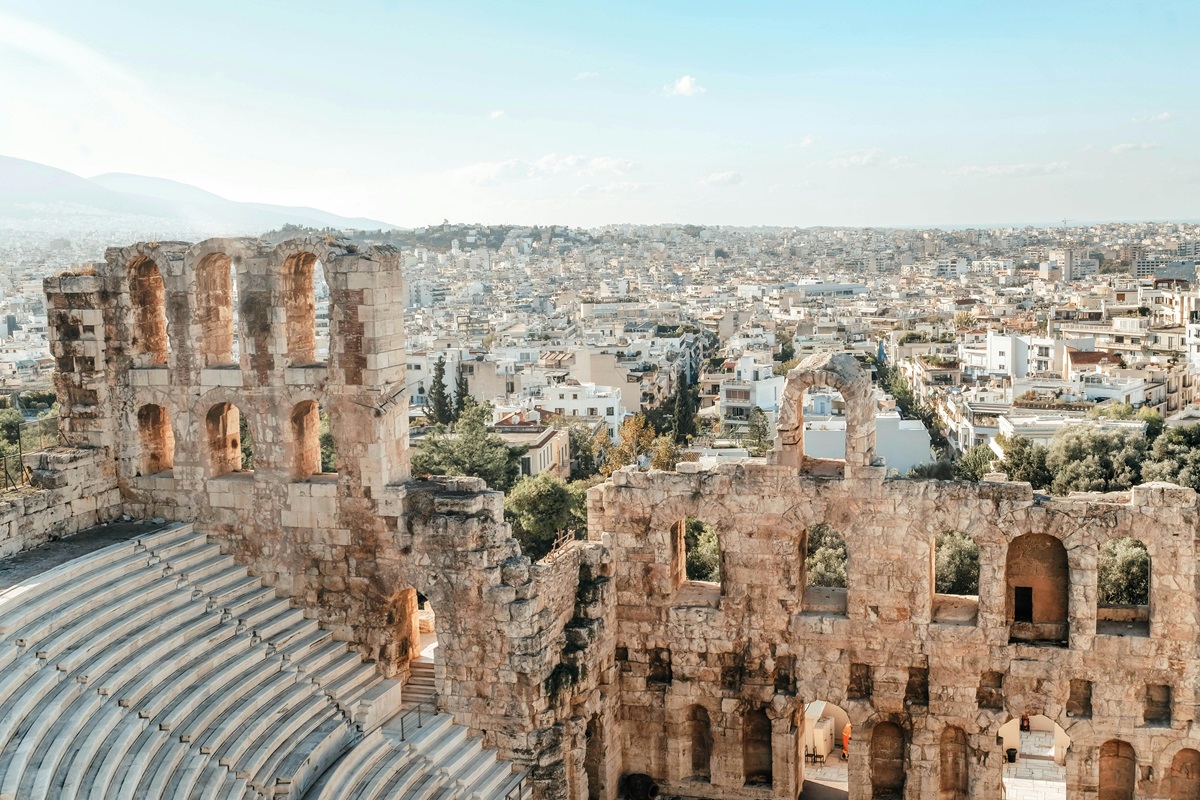
The Greeks were pioneers of drama and plays. Their theaters were open air structures carved into hillsides called amphitheaters, true architectural marvels. They could hold thousands of spectators, and their acoustics were so precise that even whispers from the stage could be heard clearly in the back rows. This was unheard of elsewhere in the world thousands of years ago.
Foundations of Modern Medicine
Hippocrates of Kos, often called the “Father of Medicine,” revolutionized medical practice in Ancient Greece. He emphasized observation and ethical conduct and introduced teachings that led to the Hippocratic Oath. It remains a guiding principle for medical professionals that is still crucial and referenced today.
A Pantheon of Powerful Gods
Greek religion featured a rich mythology centered on a pantheon of gods and goddesses who lived atop Mount Olympus. These deities, including Zeus, Hera, Athena, and Apollo, were believed to influence every aspect of life, from war and love to the harvest and the sea. Together with the Egyptian and Norse, Greek mythology is the most popular in the world and is very relevant to modern pop culture.
The Parthenon: A Masterpiece in Stone
Built in the 5th century BCE on the Athenian Acropolis, the Parthenon is a temple dedicated to Athena, the city’s patron goddess. Though it is now very weathered, it was originally adorned with colorful sculptures and intricate carvings. It showcased the height of classical Greek art and architecture, and it remains a symbol of an advanced ancient civilization.
Philosophy That Shaped the Western World
Greek philosophers like Plato, Aristotle, and Socrates laid the intellectual groundwork for Western thought. Their ideas on politics, ethics, metaphysics, and logic have profoundly influenced disciplines from science to law and continue to be studied worldwide. Later philosophers and intellectuals based their own work on them and continued many of their ideas.
Featured image courtesy of Pexels.com
