
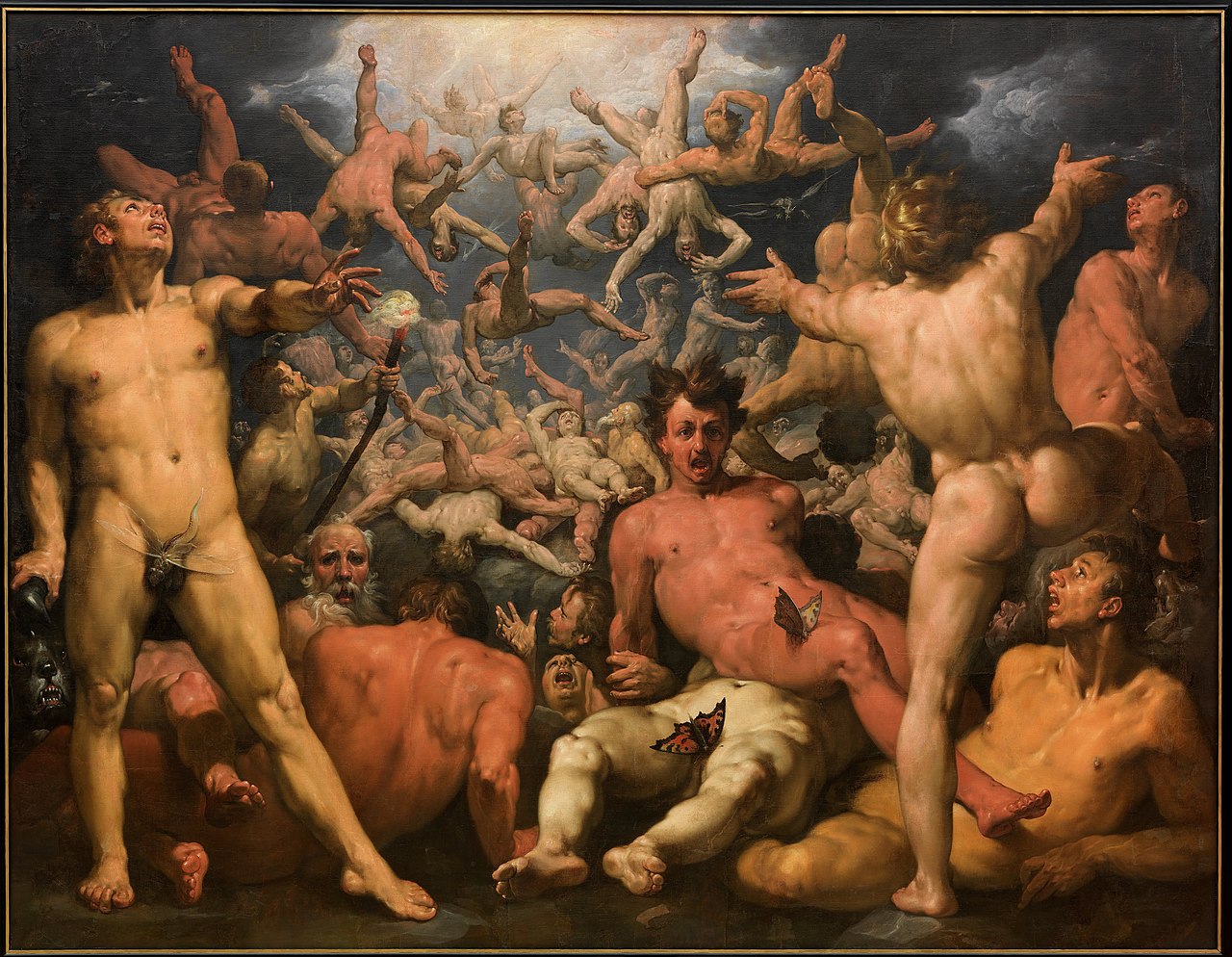
Most people have this sanitized, Hallmark-card version of the “Golden Age” in their heads—a time of eternal spring, honey dripping from oak trees, and everyone lounging around in a state of primal bliss. But if you were a child of Cronus, the Golden Age didn’t look like a vacation. It looked like the dark, acidic walls of your father’s stomach.
The Titanomachy wasn’t just a war; it was a ten-year family feud that eventually cracked the world in half. It was the moment the universe stopped being a playground for the old guard and became the high-stakes kingdom of the Twelve Olympians. This wasn’t a clean transition of power; it was a cosmic demolition derby.
A Dynasty Built on Pure Paranoia
To understand why the world caught fire, you have to understand Cronus. He wasn’t just a king; he was a man haunted by the ghost of his own father, Uranus. Having castrated his father to take the throne (an event we dive into in our guide to the Creation of the Cosmos), Cronus was terrified of the cycle repeating. He lived in the shadow of a prophecy: You will be overthrown by your own son.
Instead of being a better father, Cronus decided to be a consumer. Hestia, Demeter, Hera, Hades, and Poseidon were all swallowed whole the moment they slid into the light of the world. They didn’t die—they were gods, after all—but they were neutralized, trapped in a fleshy, divine prison.
But Cronus underestimated Rhea.
Rhea wasn’t just a grieving mother; she was a strategist. When her sixth child, Zeus, was born, she didn’t hand him over. She handed over a rock wrapped in swaddling clothes. Cronus, so blinded by his own fear that he didn’t even check the “baby’s” face, gulped down the stone. Meanwhile, the real Zeus was whisked away to a cave on Mount Ida in Crete. He grew up on goat’s milk and honey, raised by nymphs and protected by the Kouretes—warriors who clashed their shields every time the baby cried so Cronus wouldn’t hear the sound of his own downfall.
The Great Prison Break
When Zeus finally reached manhood, he didn’t just come home for dinner. He came for blood. But he knew he couldn’t take on the Titans alone. He needed his siblings.
With the help of Metis (a Titaness of wisdom who was smart enough to see which way the wind was blowing), Zeus prepared a cocktail—a potent emetic of mustard and wine. Disguised as a cupbearer, Zeus served the mixture to his father. The result was as gross as it was effective. Cronus began to heave, first vomiting up the Omphalos stone (the “rock baby”), and then, one by one, the fully grown, fully armed, and very angry Olympians.
Hestia, Demeter, Hera, Hades, and Poseidon stepped out into the light for the first time in centuries. They didn’t need a pep talk. They needed a war.
The Roster: Choosing Sides in the Chaos
The war wasn’t a simple “Gods vs. Titans” split. It was a political nightmare. You had the “Old Guard” Titans entrenched on Mount Othrys, led by the iron-fisted Cronus and the powerhouse Iapetus. These were primordial forces of nature, gods who had ruled for eons and had no intention of retiring.
On the other side, the young rebels had set up their base on Mount Olympus. But the Olympians weren’t just the six siblings. They had defectors.
This is where it gets interesting. Prometheus and his mother, Themis, were Titans, but they were also gifted with foresight. Prometheus looked at Cronus—a king who ate his kids—and then looked at Zeus, and he realized the “Old Guard” was a sinking ship. He chose survival over loyalty. His brother, Menoetius, wasn’t so savvy. He stayed with the Titans and eventually paid for it with a lightning bolt to the chest.
Then there was Oceanus and Tethys, the rulers of the world-circling river. They decided to sit the whole thing out, staying neutral and keeping their heads down while the sky fell.
For ten years, these two factions hammered at each other. This wasn’t a war of skirmishes; it was a war of attrition. Every time the Olympians made a move, the Titans countered with raw, crushing weight. It was a stalemate that felt like it would never end—until Zeus decided to go “nuclear.”
The Secret Weapons from the Basement of the Universe
A decade into the deadlock, Zeus realized he couldn’t win by fighting fair. He needed the “monsters.”
Deep in the lightless abyss of Tartarus lay the Cyclopes and the Hecatoncheires (the “Hundred-Handers”). These were the brothers of the Titans, but they were so physically jarring—one-eyed giants and fifty-headed, hundred-armed behemoths—that both Uranus and Cronus had kept them chained in the dark.
Zeus descended into the pit, killed their jailer (the dragon-woman Kampe), and offered them a deal: Freedom and nectar in exchange for your loyalty. They didn’t just join the fight; they changed the physics of it. The Cyclopes, masters of the forge, didn’t come empty-handed. They brought gifts:
- For Zeus, they forged the Thunderbolt, a weapon of such heat and force that it could blind the sun.
- For Poseidon, they crafted the Trident, capable of stirring the seas and shattering the earth.
- For Hades, they made the Helm of Darkness (or the Cap of Invisibility), allowing him to move through the enemy ranks like a ghost.
But even with these high-tech weapons, they needed the raw power of the Hecatoncheires. If you want to see how these lineages and ancient grudges intersect, this summary of Hesiod’s Theogony does a fantastic job of mapping out the family tree that led to this explosion.
The Tenth Year: When the World Screamed
The final year of the Titanomachy was a sensory nightmare. Hesiod’s Theogony describes it as a time when the very vault of heaven groaned under the strain.
Imagine the scene: The Olympians are pushing from the peaks of Olympus, Zeus is standing at the edge of the clouds, raining down white-hot bolts that turn the forests of Thessaly into ash. Below, Poseidon is literally cracking the tectonic plates, making the ground beneath Mount Othrys unstable.
Then come the Hecatoncheires.
Briareos, Kottos, and Gyes didn’t just throw rocks. With three hundred arms moving in perfect, rhythmic synchronization, they rained down a literal mountain of boulders. They didn’t just hit the Titans; they buried them. The air was thick with dust, heat, and the smell of ozone. The heat was so intense it reached Chaos at the very bottom of the universe. The sea boiled, and the Titans, blinded by Zeus’s lightning and crushed by the sheer volume of stone, finally broke.
For the first time in eternity, the “Old Guard” was on the run.
Shackles and Skies: The New World Order
The victory was absolute, and the sentencing was even more so. Zeus wasn’t a merciful winner. He didn’t want a “reconciliation.” He wanted the Titans gone.
The bronze gates of Tartarus were swung open again, but this time, the Titans were the ones being shoved inside. Poseidon himself forged the bronze wall that surrounded the abyss, and Zeus appointed the Hecatoncheires—the very monsters the Titans had once oppressed—to be their permanent jailers.
The punishment of Atlas, however, was the most iconic. As the general of the Titan army, Zeus felt he deserved something special. He wasn’t sent to the pit. Instead, he was sentenced to stand at the western edge of the world and hold up the celestial sphere—the weight of the entire sky—on his shoulders. It wasn’t just a physical burden; it was a permanent, visible reminder to anyone watching that the Titans had lost.
With the dust settled, the three brothers—Zeus, Poseidon, and Hades—did what all conquerors do: they divided the spoils. They drew lots in a helmet to see who would run which part of the reality they had just saved.
- Zeus drew the sky, becoming the King of Gods and Men.
- Poseidon drew the sea, ruling the waves and the earthquakes.
- Hades drew the short straw—the Underworld—ruling the silent dead.
The Ghost of Wars to Come
The Titanomachy was the end of the Golden Age and the birth of the Silver. But if you think this brought “peace,” you haven’t been paying attention to Greek mythology. The earth (Gaia) was furious that her children, the Titans, were rotting in Tartarus. She began brewing something even worse—a race of giants born from the blood of Uranus and the soil of the earth.The war for the throne was over, but the struggle to keep it had just begun. If you think the Titanomachy was a spectacle, wait until you read about the Gigantes. The crown of Olympus is heavy, and in this world, there’s always someone waiting in the shadows with a grudge and a hundred ways to make you regret winning.
