Among the nine Muses, there are some names that spring easier to mind, like Thaleia and Clio. Terpsichore might not be the first Muse that comes to mind, yet she has been quietly guiding our feet and voices for thousands of years. Her name means “she who delights in dance,” and that’s exactly what she does: Terpsichore is the Muse behind everything graceful, rhythmic, and harmonious.
I – always fascinated by the lesser-known deities and hero(in)es from Greek mythology – always think of the muse behind the amazing chorus of a tragedy or the silent spinning of the perfectly timed dancers. Let’s learn more about the Muse who keeps the world in step.
Terpsichore Key Facts
| Parents | Zeus and Mnemosyne |
| Consorts | Apollo, Achelous, Ares (according to various traditions) |
| Siblings | Calliope, Clio, Erato, Euterpe, Melpomene, Polyhymnia,Thalia, Urania |
| Offspring | Linus, Biston, the Sirens |
| Other names | – |
| Greek name | Τερψιχόρη (Terpsikhórē) |
| Roman Name | Terpsichore |
| Domains | Dance, choral music, rhythmic order |
| Symbols | Lyre, plectrum, laurel wreath, flowing robes, circular dance poses |
| Best known myths | Birth of the Sirens, victory over the Pierides, Death of Linus |
Name and Etymology
Terpsichore’s name is derived from two Greek words: terpō (“to delight”) and khorós (“dance”). These words together represent one of the most wonderful states, the “delight in dancing”.
The English word terpsichorean (meaning “relating to dance”) also derives from her name. While a mouthful, it is a wonderful word to remember when you wish to describe a perfectly rhythmic dance or movement.
Domain and Symbolism
In Ancient Greece, the act of dance and the chorus were a form of entertainment, of course, but they were also much more significant than that. Dance was a way to connect with the gods, or even explain the workings of the universe.
Terpsichore was the muse that inspired choral singing, dance (especially in circles and processions), and the type of rhythm and timing that gets everyone in sync, whether in a temple or a theater. Everything that keeps and retains the rhythm, from the moves of a dance to the movements of the planets, can be described as “terpsichorean”.
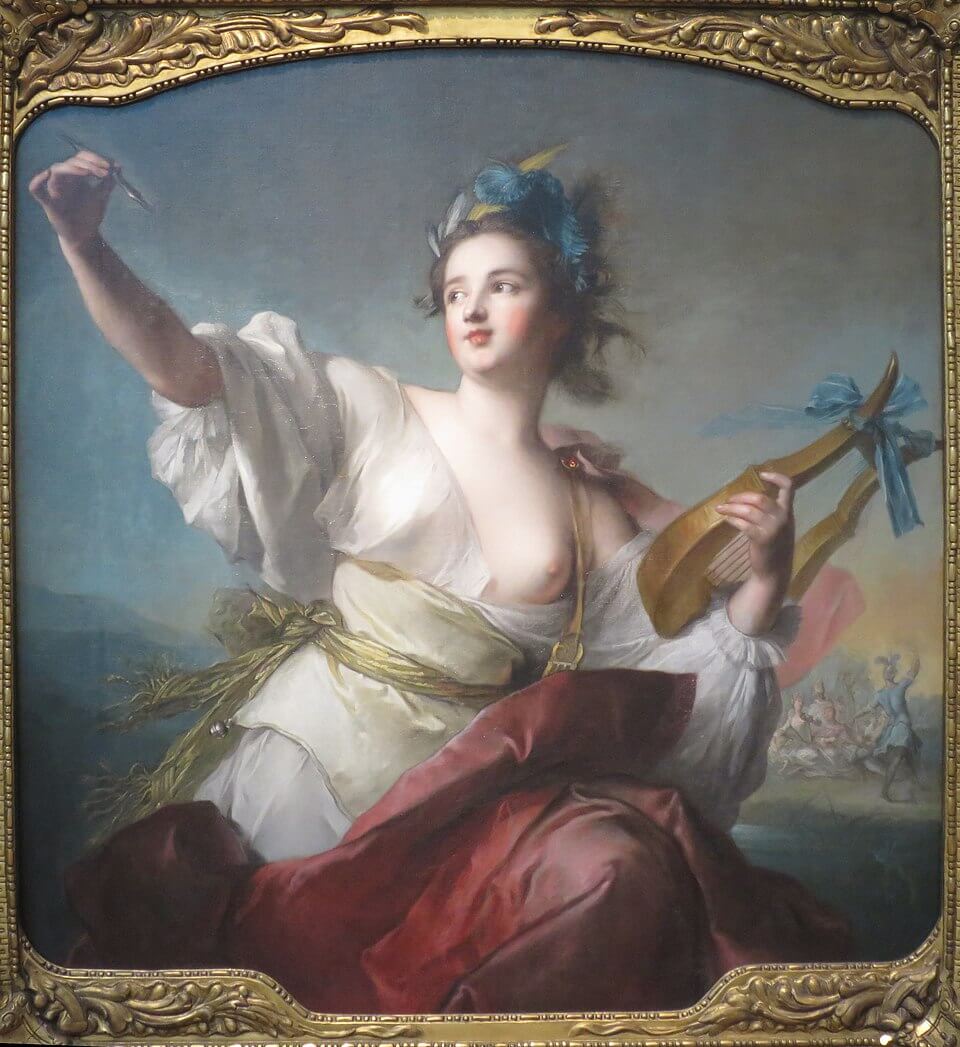
As the protectress and inspirer of the dance, artists usually show Terpsichore as a young woman crowned with laurel, seated or standing with a lyre or plectrum in hand. Her robes often seem to be swirling with movement, and she’s sometimes surrounded by other performers.
Terpsichore’s typical iconographic symbols include:
- A lyre, as the symbol of music and harmony.
- A plectrum, for plucking the lyre.
- A laurel wreath, awarded for excellence and artistic achievement.
- Flowing robes, for the elegance and graceful movement of dance.
- Circular dance poses, to emphasize the communal aspect of Greek dance.
Family and Relationships
Terpsichore, like her eight sisters, is the daughter of Zeus (king of the gods) and Mnemosyne (Titaness of Memory). The rest of the Muses are: Calliope, Clio, Euterpe, Erato, Melpomene, Polyhymnia, Thalia, and Urania. Together, they preside over every art and science, while each brings a unique flavor to the Ancient Greek artistic thought.
Terpsichore is sometimes described as having a special connection to Apollo, the god of music, and in some traditions, she is paired with Achelous, the river god, or even Ares, the god of war. These relationships, according to various myths, make her the mother of the legendary musician Linus, the Sirens—those famously dangerous singing creatures—and the Thracian king Biston.
Terpsichore in Mythology
Mother of the Sirens
One of Terpsichore’s most famous mythological roles is as the mother of the Sirens. According to Apollonius Rhodius and other ancient authors, Terpsichore gave birth to the Sirens with Achelous, the river god.
Before their transformation, the Sirens were companions to Persephone, singing and dancing for her. But after Persephone’s abduction to the underworld, the Sirens were changed – some say as a punishment, others as a gift – and became the well-known haunting voices, whose songs lured sailors to their doom.
Dirge for Linus
In another poignant myth, Terpsichore is said to have mourned her son Linus – a legendary musician – by inventing the first lament. Through her sorrow, she gave the world threnodies and dirges. She was not just a muse of joyous celebration, but also of the deep, rhythmic expression of grief. Her influence, therefore, is felt wherever music helps people express their emotions, whether happy or sad.
The Cosmic Dance
In a more recent theory, Terpsichore’s influence is said to reach into the heavens themselves. Philosophers such as Plato used her as a symbol for the harmonious, orderly movement of the cosmos. The planets, the seasons, and even the cycles of life were imagined as participating in a grand, cosmic dance orchestrated by Terpsichore. Later thinkers and scientists would use her name to describe any beautifully repeating motion in nature.
Participation in Mythic Events
Terpsichore appears in stories involving all of the Muses, including the famous contest with the Pierides (Pierus’ daughters). When the competition began, Terpsichore and her sisters performed with such flawless artistry and unity that the judges had no doubt who the victors were. The Pierides, punished for their hubris, were transformed into magpies, doomed to chatter endlessly, never achieving the harmony and grace of the Muses. She also participated in mythological events such as the wedding of Cadmus and Harmonia and the burial of Orpheus.
Depiction and Characteristics
If you were to spot Terpsichore in ancient art, you would likely see her sitting on a rock or bench, one foot ready to leap into motion, and a lyre in her hands. In Roman mosaics, she is more often standing, with her robes swirling as if caught mid-step. Renaissance and later artists kept her graceful, always poised and serene, always focused but always joyous.
We need to note that she is not wild like Dionysian dancers or stern like Athena. Terpsichore embodies balance, joy in order, beauty in movement, and a sense of community.
Worship and Cult
Although Terpsichore never had a temple dedicated solely to her, she was honored alongside her sisters at prominent sites throughout Greece. The springs of Mount Helicon, believed to have been created by Pegasus, were sacred to the Muses, as was the Castalian Spring near Delphi on Mount Parnassus. Pieria in Macedonia was said to be the original homeland of the Muses, and local communities held festivals where singing and dancing competitions were common.
During these festivities, known as the Museia, poets, choruses, and dancers competed in the Muses’ honor, hoping for their blessing and inspiration. Even in the secretive rites of the Eleusinian Mysteries, worshippers would dance in circles through the night, reenacting the cycles of life and death, and drawing upon the rhythm and balance that Terpsichore represents.
Legacy and Influence
Mentions in Ancient Texts
In the ancient world, Hesiod lists Terpsichore as one of the original nine Muses, while Pindar refers to her as the “mistress of the lovely choir.” Plato’s Phaedrus even claims that grasshoppers report the best dancers directly to her on Olympus. Authors such as Apollonius and Nonnus connect her to the Sirens, crediting her with their enchanting but dangerous music.
Artistic and Literary influence
Terpsichore has been a favorite subject for artists seeking to capture motion and harmony, from the sculptors of Hadrian’s Villa to the mosaicists of Pompeii and beyond. Book V of Herodotus’ Histories is titled “Terpsichore,” and Michael Praetorius’s influential 1612 dance collection also bears her name.
Throughout history, poets, composers, and choreographers have invoked Terpsichore as the gentle muse behind every graceful step and blended voice, shaping the way people think about rhythm and beauty.
Modern Culture
The name of Terpsichore is used in ballet schools, dance companies, and even Broadway productions. The word “terpsichorean” is still used to describe anything related to dance, and scientists have borrowed her name to describe elegant, periodic movements in nature.
Conclusion
Terpsichore is the Muse who brings people together through dance, song, and rhythm. She reminds us that movement is about unity, balance, the joy of being part of something bigger. Throughout the antiquity, dance was a very important part, as it also is in modern Greece. We must think of Terpsichore as the spirit of grace in motion, as the pulse behind the rhythmic order of the universe. So, next time you take a look at the stars or dance in a Greek island, remember the graceful Muse that inspires everything.
Frequently Asked Questions
What does Terpsichore’s name mean?
It means “delight in dancing,” from the Greek words for “delight” and “dance.”
What is Terpsichore the Muse of?
She is the Muse of dance, choral music, and rhythmic order.
How is Terpsichore depicted in art?
As a graceful woman with a lyre, often sitting or standing as if about to dance, crowned with laurel or flowers.
Did Terpsichore have any children?
Traditions Terpsichore is the mother of the Sirens, Linus, and sometimes Biston.
Where was Terpsichore worshipped?
She was honored as part of the group of Muses at Mount Helicon, Pieria, and Mount Parnassus, especially at temples, shrines, and sacred springs.
Further Reading/References
Michael Praetorius – Terpsichore (1612 dance collection)
Hesiod – Theogony
Pindar – Odes and Fragments
Apollonius Rhodius – Argonautica
Diodorus Siculus – Library of History
Nonnus – Dionysiaca
Plato – Phaedrus
Murray, Penelope – “Plato’s Muses: The Goddesses that Endure”
Featured image: Painting by Jean-Marc Nattier: Terpsichore, Muse of Music and Dance. In the Public Domain.
