
The world of Ancient Greece, often celebrated for its philosophy, democracy, and epic poetry, was also a realm where the capricious hand of chance held significant sway. From the cosmic distribution of power among the gods to the quiet leisure of heroes, games involving luck and fortune permeated both myth and art, revealing a society deeply familiar with, and often fascinated by, the roll of the dice and the drawing of lots.
A Divine Gamble: The Cosmic Division of Power
Perhaps the most monumental game of chance in Greek mythology is the drawing of lots by Zeus, Poseidon, and Hades. After their triumphant overthrow of their father Cronus and the other Titans, the three powerful brothers faced the immense task of dividing the universe among themselves. Rather than engaging in a power struggle, they resorted to a method as ancient as it was democratic: they cast lots. Zeus drew the lot for the sky and sovereign rule, Poseidon for the sea, and Hades for the underworld, while the earth and Mount Olympus were to be shared.
This foundational myth illustrates the profound role of chance in establishing even the highest cosmic order, suggesting that fate itself could be determined by a single draw. If you feel like trying your luck at gambling with somewhat smaller stakes than the whole universe, you can visit Ice casino where you can try any number of different games of chance.
Heroes at Play: Achilles and Ajax at the Game Board
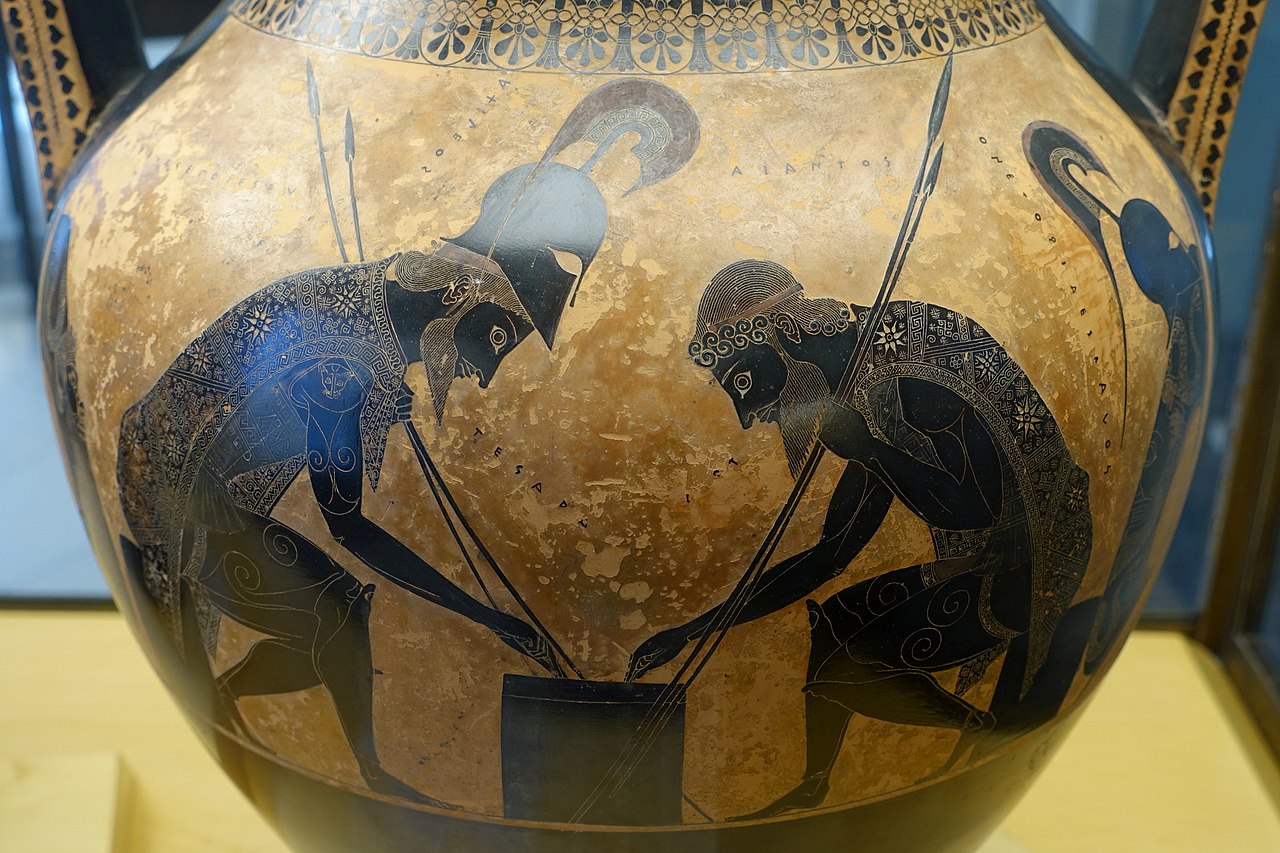
One of the most iconic depictions of ancient Greek gaming comes not from a text, but from a pot. The black-figure amphora by Exekias (c. 540-530 BCE) captures a poignant moment during the Trojan War: the mighty warriors Achilles and Ajax are shown engrossed in a board game.
The scene, depicting them in full armor but momentarily at ease, highlights a human element amidst the brutal conflict. While the exact rules of their game, likely petteia or a similar dice-based board game, remain a subject of scholarly debate, the image clearly shows an activity involving chance and strategy. Achilles, with his helmet slightly tilted back, announces “four,” while Ajax, deep in thought, calls out “three,” suggesting a dice roll or similar numerical outcome dictating their moves. This vase eloquently demonstrates that even the greatest heroes sought respite and challenge in games of fortune, a universal human trait.
Knucklebones and Chance: The Game of Astragaloi
Beyond the epic narratives, daily life in Ancient Greece was rife with smaller-scale games of chance. Astragaloi, or knucklebones, were among the most popular. These were the ankle bones of sheep or goats, naturally irregular in shape, with four distinct sides. Players would toss these “dice,” and the combination of how they landed determined the score. The most coveted outcome was the “Throw of Aphrodite,” where all four knucklebones landed on different sides, signifying great luck and often winning the highest stakes. Conversely, the “Throw of the Dog” was the worst, with all four bones landing on the same, least favorable side. Countless terracotta figurines, reliefs, and vase paintings depict men, women, and children playing astragaloi, underscoring its widespread appeal as a form of entertainment and, often, a means of gambling.
The Philosophers’ View: A Moral Dilemma
While games of chance were woven into the fabric of Greek society, they were not without their critics. Many Greek philosophers and moralists viewed gambling with disdain, often condemning it as a vice that led to idleness and ruin. The term $\kappa\upsilon\beta\epsilon\acute{\iota}\alpha$ (kubeia), referring specifically to dice-playing and general gambling, frequently appears in critical contexts. Playwrights and rhetoricians sometimes depicted gamblers as desperate figures losing their fortunes, using their plight as a cautionary tale. This philosophical opposition highlights the tension between the inherent human attraction to risk and fortune, and the societal desire for order and virtue.
In conclusion, the presence of gambling and games of chance in Ancient Greek myths and art offers a window into the diverse facets of their culture. From the divine lottery that shaped the cosmos to the casual diversion of warriors and the everyday pastime of ordinary citizens, the Greeks were profoundly aware of the role of luck in life. These depictions remind us that the human fascination with fortune, risk, and the thrill of the unknown is a timeless phenomenon, deeply rooted in the annals of history.
